Roundtable: Resonance of Quantum and Intelligence · Diverse Paths: Co-building the Next Decade of China's Quantum Industry | 36Kr 2026 Industrial Future Conference
In 2026, industrial investment has entered a deep-water zone, where capital, technology and industry are accelerating integration. The old investment logic no longer applies, and new consensus is taking shape. The 2026 Industrial Future Conference focuses on opportunities in the new cycle, and jointly explores the future of the industry and the birth of the "Light of China". From September 9 to 10, the 2026 Industrial Future Conference hosted by 36Kr was held in Yizhuang, Beijing under the theme of "Resonance and New Birth Above the Deep Water". Participants from state-owned capital platforms, industrial investment funds, corporate CVCs, innovative enterprises, experts and scholars gathered to focus on the industrialization of future industries such as quantum technology. The conference conducted in-depth discussions on current cutting-edge technology and industrial perspectives, intensively demonstrated breakthroughs in technical routes such as superconductivity, photonic quantum, and ion trap, shared a large number of specific industrial scenarios, industrial system construction, and the prospects of heterogeneous computing, to jointly explore the future of technology industrial investment.
The following dialogue is sorted and edited by 36Kr:
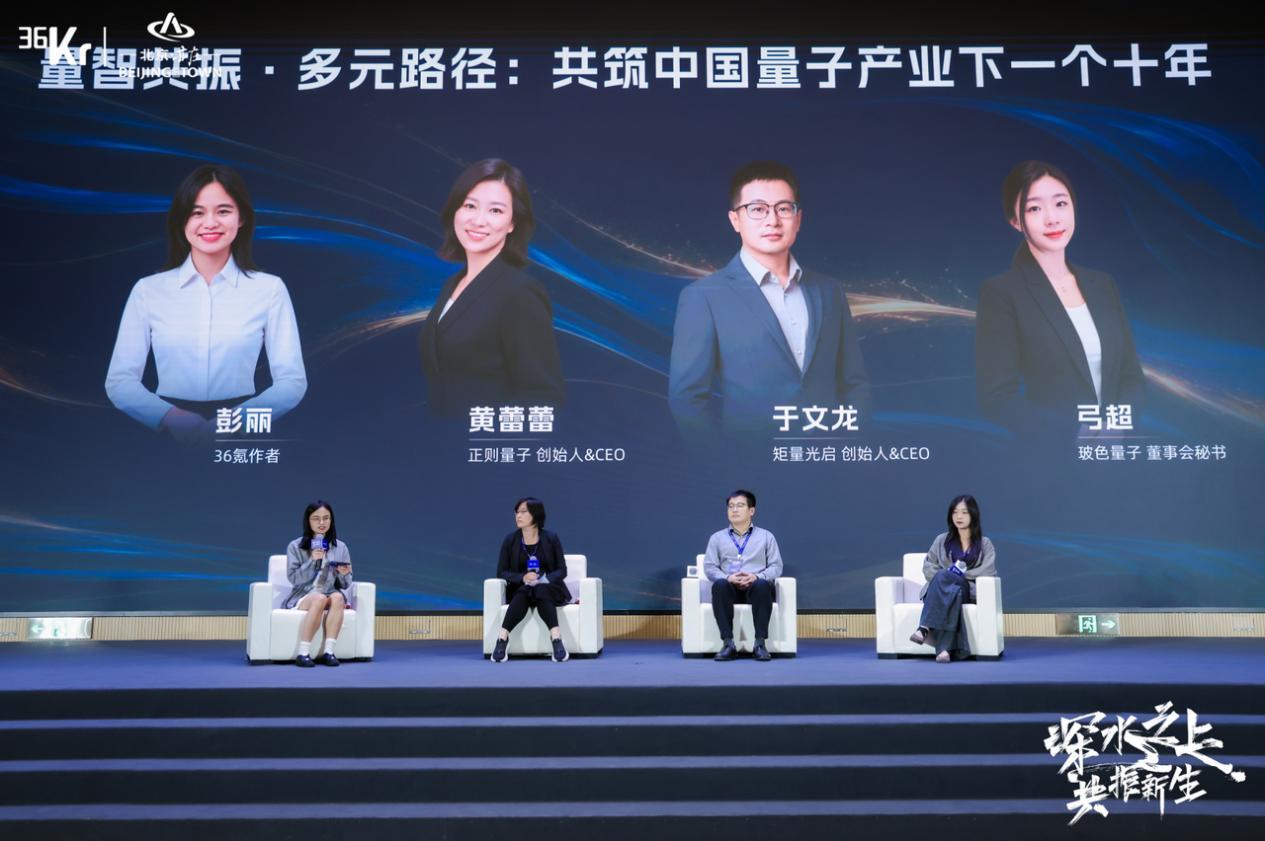
Host:
Peng Li, Author of 36Kr
Guests:
Huang Leilei, Founder & CEO of Zhengze Quantum
Yu Wenlong, Founder & CEO of Momentum Photonics
Gong Chao, Board Secretary of Bose Quantum
Peng Li: Good afternoon to all friends on site and online, I am Peng Li, author of 36Kr, and I am very glad to be the host of today's roundtable forum.
If we say that in the past few years, our discussion of quantum computing was mostly about proof of concept in the laboratory, standing at the point of 2026, as the theme of today's roundtable says, we are feeling the unprecedented resonance of quantum intelligence.
Today we are more curious about the characteristics of different technical routes, how they can develop in the future, and what kind of industrial scenarios they will enter. Now let's talk about the next decade of the quantum industry.
First of all, we have three guests on site, who come from different enterprises and represent different technical routes. Let's invite each guest to introduce themselves first, explain the principle and characteristics of the route they represent. Mr. Huang, please start.
Huang Leilei: Hello everyone, I am Huang Leilei from Zhengze Quantum. Our company takes the full-stack integrated hardware-software photonic quantum technical route. Photonic quantum essentially uses photons as the core carrier of quantum information. As for the advantages of light, I just heard Mr. Song explain each technical path very clearly. The advantage of light is that it is relatively stable, can run at room temperature, and is compatible with existing communication networks and future quantum networks. Its disadvantage is that there are some problems in large-scale entanglement and loss.
At present, based on self-developed core underlying photonic chips, and the two-line strategy of dedicated photonic quantum computers and general-purpose photonic quantum computers, our company is actively promoting the landing application of current quantum computing in various industries. Thank you!
Yu Wenlong: Good afternoon, all guests. I am Yu Wenlong from Shanghai Momentum Photonics Computing Technology Co., Ltd. Momentum Photonics is an enterprise engaged in the whole machine of superconducting quantum computers. Superconducting quantum computing has now entered a stage of rapid development in terms of industrialization and engineering. Our company can provide full-stack technical services from chip R&D and manufacturing to whole machine integration, and subsequent landing of industrial application solutions.
Gong Chao: Hello everyone, I am the board secretary of Bose Quantum, my name is Gong Chao. Bose Quantum was founded in Beijing, taking "practical quantum computing" as the core, and adhering to the two-line strategy of "dedicated quantum computing first, long-term layout of general-purpose quantum computing". Bose Quantum adopts the coherent photonic quantum computing route. The feature of this route is that it does not rely on general quantum logic gate circuits to complete calculations, but maps suitable problems to corresponding physical models, and then solves them through physical evolution processes.
The main features of this route include the scalability of computing scale and the use of physical system evolution to solve problems. At the same time, our equipment can run at room temperature, which is conducive to reducing the requirements for the operating environment, so the corresponding deployment cost and whole machine energy consumption are relatively low. In general, we believe this is a practical-oriented technical route.
Peng Li: Thank you for the introductions of the three guests. The first question I want to talk about from the perspective of the industry is, at the current time node, how do you view the current industrialization stage of quantum computing in China. If you need to use a core indicator to measure the development of quantum computing in the next 3-5 years, what will your answer be?
Huang Leilei: Looking at it from 2026 now, I think the quantum industry has been transformed from the original scientific research experiment to engineering, especially to some specific dedicated landing application scenarios. To give a very simple example, before the end of last year, when you talked to customers about quantum or quantum computing, more than 80% or 90% of customers thought this concept was very good, but it was too cutting-edge for them to use.
This year there is a very good point, you will find that many customers are willing to make such attempts, they will take the initiative to come to us and say, although I do not understand quantum computing, can you help me see what the combination point between our business and quantum is. So I think this is a very good time, especially for companies that were originally more focused on scientific research applications, to truly integrate with industrial landing.
As for the indicator issue you just mentioned, I think the most important indicator, which Mr. Song also mentioned just now, is that you no longer simply look at simple numbers such as physical bits, but turn more to how much efficiency improvement your quantum computing power can really bring to the current needs of customers. So I think the core indicator in the next 3-5 years is whether we can find several points, even if there are only 1 or 2 landing points of customer scenario applications, you can prove that it has efficiency and performance improvement compared with classical computing. Moreover, this kind of solution should be replicable and large-scale promoted in a certain vertical field, I think this is the core indicator in the future.
Peng Li: Understood, what is Mr. Yu's answer?
Yu Wenlong: Since entering 2026, we feel that the entire Chinese quantum computer industry has entered the initial stage and is developing rapidly. For example, the entire primary market was very hot in the first half of this year. The factor driving this change is that this technology is becoming more and more mature, moving from the laboratory to real industrialization landing.
In the next 3-5 years, although the development is very rapid, there are still many challenges in the middle. In the next 3-5 years, to judge whether a quantum computer system has really entered the application, in fact, it depends on whether it has the ability to solve real problems, rather than some specific single indicators. The goal in this regard is very clear, all practitioners in the entire quantum computer field are working to actively apply quantum computers to practice to solve real business problems. After all, quantum computers are essentially computers, and the entire ecosystem in this regard is gradually recognizing this capability. For example, they actually know better than customers the difficulties and bottlenecks they encounter in the existing computing power ecosystem. In this case, they will also actively seek a new computing paradigm, such as the paradigm of quantum computing.
Therefore, the entire industry, from the upstream industrial chain to the whole machine enterprises, as well as downstream application solutions and customer demands, are actively promoting the development of the industry.
Gong Chao: I think for the leading participants in the quantum computing industry, whether in China or the United States, they are generally in the stage of moving from the laboratory to the industry.
Specifically, it may need to be discussed separately:
For general-purpose quantum computing, I think it is now in a stage where everyone uses engineering methods to solve the error correction problem, and some very positive progress has been seen. This year we also very much expect general-purpose quantum computing to achieve some high-quality logical bits, and see some progress in POC of real commercial applications.
For dedicated quantum computing, as written in the "15th Five-Year Plan", the core indicator or task in these 5 years may be scalability. In the past few years, some small-scale applications have been verified in some real application scenarios and real business problems. Whether this advantage can be expanded to a larger scale to better meet the actual needs of customers and create commercial value, I think this is what dedicated quantum computing should achieve in the next 3 to 5 years.
Peng Li: Thank you for your answers. It sounds like everyone's consensus is that the industry will definitely move towards industrialization and real scenarios in the future.
Next, I would like to ask Mr. Huang, the photonic quantum route is often considered to have its own advantages in quantum communication and quantum networks. Do you think that if quantum computing wants to truly enter the industrialization stage in the next 10 years, at which stage will photonic quantum take the lead in establishing its own advantages, is it the computing itself, the quantum network, or other scenarios that have not been fully realized today?
Huang Leilei: In the next 10 years, in the 10-year cycle, there may indeed be some scenarios that were not expected in the early stage. As far as the current situation is concerned:
First, when light is used for computing, it has innate advantages in dedicated scenarios. For some specific graph theory, optimization solution and other scenarios, dedicated photonic quantum can be implemented first in the near years.
Second, in addition to computing, I personally think that light in the network, especially distributed quantum computing, no matter it is superconductivity, ion trap, or neutral atom, all are talking about distributed quantum computing. Although everyone is doing quantum computing and the technical paths are not converging, one point is absolutely converging: the future quantum computing is definitely inseparable from the core technology of photonic quantum. You need very good light sources, very good photonic quantum line chips and photonic detectors, this part is absolutely certain.
Third, light is not only used in computing networks, but also has some innate advantages in some quantum sensing scenarios.
Therefore, I think in these different levels in the future, there will be a systematic interaction in industrial landing, which may be the relative advantage of light over other paths.
Peng Li: We just talked about these advantages of light. What do you think is the most critical factor that needs to be solved to determine whether the photonic quantum route can finally succeed?
Huang Leilei: In my opinion: First, because light and superconductivity are now the only two routes that have achieved quantum superiority, we need to prove that they are better than existing classical computing on some specific useful problems. Second, on the general-purpose photonic path, we need to find a way to solve the problem of large-scale entangled photon pair generation and reduce the optical loss. I think these two are very core points.
Peng Li: Thank you for Mr. Huang's answer. The next question is for Mr. Yu. The superconductivity route is currently considered to be the most mature route in engineering. In the semiconductor and hard technology fields, everyone also has the concept of "middle technology trap". In short, the technology may be out, but there is still a certain distance from high yield and large-scale mass production.
I would like to ask you to talk about: First, what capabilities of today's semiconductor industry can be reused for quantum computing? Second, if the superconductivity route is to truly move towards large-scale development, what are the most important engineering problems that need to be solved?
Yu Wenlong: Superconducting quantum computing is actually at the forefront of engineering and industrialization. The reason why it develops so fast is that the entire superconducting quantum computing industry chain is very mature and complete. For example, superconducting quantum chips are highly dependent on current advanced semiconductor equipment, production lines and processes. The entire development of superconducting quantum computing is gradually moving from laboratory to engineering and industrialization. In terms of professional semiconductor equipment and production line capabilities (wafer manufacturing capabilities), it will play an increasingly important role in the development of the entire quantum chip industry.
Many advanced chip processing technologies will greatly promote and improve the development of the entire superconducting quantum chip, thus promoting the development of superconducting quantum computers. Although superconducting quantum computers seem to be at the forefront of industrialization, they actually face many problems to be solved in the future of large-scale commercial use. From all engineering links and dimensions, although semiconductor equipment and processes are already very advanced, there are still great challenges in improving the yield, stability, uniformity of superconducting quantum chips and even reducing costs.
We use a very low temperature for the dilution refrigerator to ensure the stable operation of quantum chips. In this regard, there have been some breakthroughs in the large-scale manufacturing and even modular manufacturing of dilution refrigerators, but it still requires industrial chain partners to actively expand.
Finally, distributed computing and large-scale integration capabilities, to solve large-scale problems, this aspect requires algorithms and system integration capabilities, so each link is a very big challenge.
To make the entire system run effectively, it is not by solving a single problem, but to ensure that all links of the entire system have no obvious shortcomings. It is a highly integrated system, which is very different from the digital computers in the semiconductor industry.
Peng Li: The next question I want to ask Mr. Gong, Bose Quantum previously proposed the route of "dedicated quantum computing first, long-term layout of general-purpose quantum computing". Including what you just mentioned, Bose Quantum has had multiple cases in the direction of commercialization. First of all, can you talk about what its business model is probably like at present?
Gong Chao: For the business model of dedicated quantum computing, I think dedicated quantum computing is a bit like the state of the early IDC, which is the deployment stage of computing power infrastructure. It can be roughly described in this way. In many specific industries, especially in biopharmaceuticals, finance, transportation and logistics, application exploration has been seen, including we are also actively cooperating with many end users or intermediate service providers in new drug R&D and new material discovery, such as CRO or AIDD companies, and have formed some joint achievements.
But in the process, no matter it is a scientific research institution or a startup, the cost of investing in the deployment of quantum computer hardware is a relatively big challenge for them. So today we see the emergence of many platform parties. The role of the platform party may be a local government state-owned capital platform, a large scientific research institution, or a large state-owned enterprise or listed company. As the construction or operation subject of computing power infrastructure, they deploy quantum computing hardware facilities, and then provide them to end users in the form of computing power. The whole chain is roughly like this.
For our company, one business model is whole machine sales, facing these platform parties or infrastructure builders. On the other hand, we provide computing power services and professional technical support for end users. In some fields where exploration is progressing rapidly, we are also working with partners to jointly promote the construction of application achievements.
In the future, we also hope to explore the commercial transformation of joint achievements and the corresponding income distribution mechanism. This is the direction we further explore beyond our existing business.
Peng Li: From the current practice of your company, do you think the biggest challenge of dedicated quantum computing at present is that the computing power itself is not enough, or to find scenarios that can continuously generate commercial value?
Gong Chao: I think this is very clear. Facing the larger-scale application demand, the current computing power supply still needs to be further improved. As I said just now, I think the deployment of dedicated quantum computer computing power infrastructure is only at the beginning stage. In terms of hardware, with the expansion of bit scale, the stability and continuous operation capability of equipment still need to be further improved to meet the usage needs of customers.
On the other hand, the entire application exploration ecosystem is still in its initial stage. But in fact, in the past few years, I think dedicated quantum computing has already demonstrated its ability to solve real business problems and real problems, and we will also compare it with some classical methods or artificial intelligence methods. Now it has achieved clear advantages in very clear large-scale combinatorial optimization problems, especially after we combine some machine learning capabilities, such as doing quantum Boltzmann sampling, to solve some analysis and design or new material design problems.
But as I mentioned just now, the problem now is whether these advantages can be expanded to a larger scale, and further adapt to the problem scale and usage requirements required by the production environment, which definitely requires the support of larger-scale computing power. Now customers have put forward higher requirements to us, pushing us to further improve our capabilities around specific needs.
Peng Li: If we extend the time to a ten-year dimension, from the perspective of your respective companies, do you think quantum computing will eventually move towards a mainstream route, or will multiple routes run in parallel for a long time?
Huang Leilei: I read a sentence before that we will always overestimate the present and underestimate the future. In fact, from the perspective of 10 years, first of all, no one can answer this question. If someone